Fit for purpose: evaluation and evolution of agricultural bioinoculants across production landscapes
Jul 10, 2026· ,,,,,,,·
0 min read
,,,,,,,·
0 min read
Lauren Hemara
Rebecca Doyle
George DiCenzo
Matthew Bakker
Kailey Hopkins
Jangwoo Lee
Ivan Oresnik
Terrence Bell
Abstract
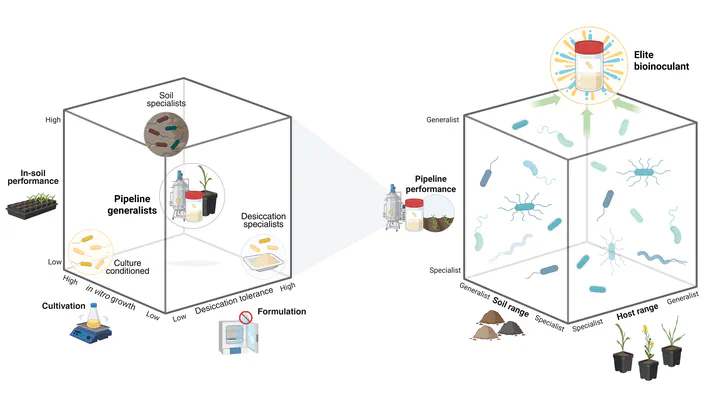
Microbial inoculants are currently advancing sustainable agriculture by reducing reliance on chemical fertilizers and pesticides, and enhancing soil and plant health in ways that traditional chemical inputs cannot. However, despite over a century of research and development, their in-field establishment and performance remain unreliable, limiting their widespread adoption and impact. Typically, the selection of candidate inoculants centers around performance-based traits (eg, nitrogen fixation) assessed in vitro, yet viable and impactful inoculants must express a wide range of traits that promote their fitness across heterogeneous landscapes. Successful inoculants must do well across the industrial production pipeline, which requires rapid growth in nutrient-rich liquid media. They must also tolerate long-term storage and subsequently perform consistently across diverse field conditions. These traits are essential for scalability, economic viability, and impact. To date, commercially available inoculants are mostly based on microbes exhibiting rapid growth under common lab conditions, traits which may or may not correlate with in-field delivery of beneficial functions. In this review, we propose a multi-faceted evaluation approach for inoculant performance, considering both biotic and abiotic aspects of inoculant success. We then use this framework to evaluate how adaptive laboratory evolution could enhance inoculant performance at key industrial pipeline steps. This approach is essential to widening the range of taxa that are considered for commercialization, while identifying and potentially mitigating the pitfalls of growing, storing, and applying microbes through traditional industrial production pipelines.
Type
Publication
ISME Communications