Individually redundant effectors are collectively required for bacterial pathogen virulence
Nov 26, 2025· ,,,,,·
0 min read
,,,,,·
0 min read
Lauren Hemara
Mark Andersen
Haileigh Patterson
Marion Wood
Matthew Templeton
Jay Jayaraman
Abstract
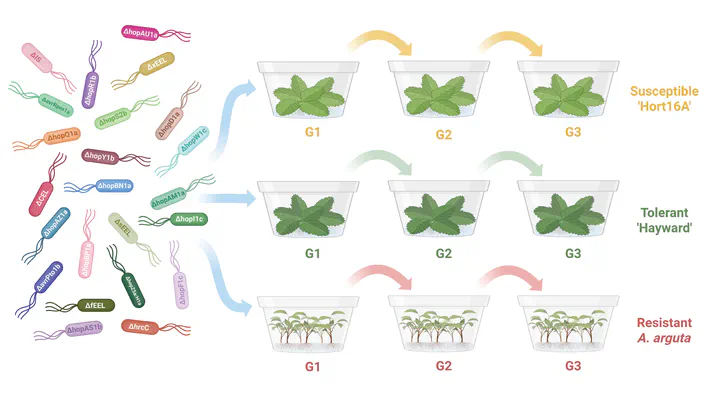
Host specificity of a plant pathogen is defined by its effector complement. However, it remains unclear whether the full complement is required for pathogenicity. Pseudomonas syringae pv. actinidiae (Psa) is an emerging model pathogen of kiwifruit with over 30 functional effectors, providing a unique opportunity to understand how host-mediated selection shapes pathogen evolution. The majority of Psa’s effectors previously appeared non-essential in single knockout contexts. Why, then, does Psa maintain such a large repertoire? We sought to examine effector requirements, redundancies, and repertoire refinement across host genotypes through a mutated effector-leveraging evolution experiment (MELEE), serially passaging competitive populations of effector knockout strains. Competition suggests that all effectors are collectively required for successful virulence, demonstrated by the dominance of wild-type. Host-specific effector requirements identified may further explain the maintenance of this large effector repertoire, providing important insights into the dynamics of effector redundancy following incursions.
Type
Publication
The ISME Journal
Effector Requirements
Effector Recognition
Type III Effectors
Pseudomonas Syringae Pv. Actinidiae
Kiwifruit

Authors
Postdoctoral Fellow
Lauren Hemara is a Postdoctoral Fellow at the University of Toronto Scarborough.